Down memory lane
Governing bodies of pretty much all sports love a pathway. That is a talent pathway by the way. Cricket is no different. The professionalisation of the sport means that a supply of players is always needed. Some come ready-made but most have to be (or indeed should have to be) developed over a period of time.
Pathways are nothing new, apart from the name. Schoolboy cricket in the Leinster clubs only began in the 1940s with the advent of Vacation Cricket, however school cricket had operated alongside adult cricket from the mid 1800s with a representative element from 1906 when Leinster and Ulster Schools first locked horns. The great Jimmy Boucher was capped as a schoolboy, undoubtedly someone was tracking him. As a route to representative cricket, Under 19 interprovincials were first played in 1969 with an under 15 version appearing in 1977.
So pathways have been around for some time and have served Irish cricket very well. The Irish under 19s first played in the International Tournament in 1975 and while none of the players would go on to Senior international level, there were some fine players. The next version in 1977 was hosted in England and a total of six players would go on to full honours (Brian Gilmore, Paul Jackson, Stephen Warke, Garfield Harrison, Jim Patterson and John McDevitt). That was excellent but 1981 and 83 both produced seven full caps in due course. The pathways are generally targeted at youth age levels but occasionally the powers that be, recognise that not everyone develops at the same age or way.
Today is a trip down memory lane. Despite previous tours it was a bit of a surprise when the Irish Cricket Union announced that they would be sending an Under 23 team to tour Scotland in August of 1986. Previously, a similar group had gone to Northumberland as an under 21 side but poor memory and zero ICU records means that the only way I know it happened is by the cap in the attic that I received for it, when it was and any details are lost in a fog, I fear. 1984 had also seen a trip to the Midlands (England rather than Mullingar) for a similar aged side.
A trip to Scotland is always welcome and with 4 games scheduled over the 5 days it was sure to be a challenge. The games were:
v East of Scotland at Stenhousemuir
v North of Scotland at Sterling
v West of Scotland at Greenock
v Scotland under 23 at Ayr (2 day game)
The 13 man squad were captained by Alan Lewis of YMCA, while the rest of 13 man squad was Michael Rea (Trinity and Bangor), John Browne (Sion Mills) Jonathan Garth (YMCA), John Hoey (YMCA), Marshall Kilgore (Brigade), Junior McBrine (Donemana), James McBrine (Donemana), Philip Lennon (Downpatrick), Johnny McGrath (Trinity and Old Belvedere), Peter Reid (Lisburn), Alan Waite (Waringstown), Deryck Vincent (Clontarf).
Off spinner,Michael Shannon from Holywood had been included in the squad initially however he had to withdraw and Philip Lennon was a like for like replacement.
And if some of those names look familiar to younger readers, yes Alan Lewis is the father of Gabby, Jonathan Garth is the father of Kim, John Hoey is the brother of Conor and uncle of Gavin, Junior is Andrew’s Dad and James his uncle. It is fair to say that the genetic pathway has served Irish Cricket well (and Australia).
Management for the tour consisted of ICU Secretary, Derek Scott, ICU President, Alfie Linehan and Chairman of Selectors Alec O’Riordan and Senior selector Eoin McCann. Not a coach or support staff in sight, however, Alec O’Riordan was held in such high esteem by the players some of whom had the good fortune to play against and indeed alongside him, that he effectively acted as a coach to the team.
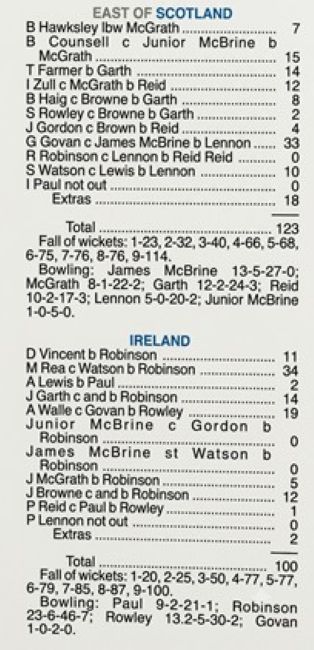
And so to the cricket. Sean Pender from the Irish Times fully expected Ireland to win all the games leading up to the final “international” and the disappointment in the report filed after the first game against East Of Scotland “by a special correspondent”, a thinly disguised Derek Scott, was plain to see. Fielding first on a murky day in Senthousemuir was a good start. While it was a damp dark day, the football stadium was still visible and the conditions favoured the bowling side. East totalled just 123. Peter Reid was the star of the show with 3 for just 17 in his 10 overs. Jonathan Garth also took 3, with 2 for Johnny McGrath and Philip Lennon. At 76 for 8, things might have been even better but the last 2 wickets put on 47 runs which ultimately was the winning of the match. G. Govan (any relation to Jim, who would later relocate to Dublin?) was the biggest contributor with 33. The reply was underwhelming with opening bowler R. Robinson producing an outstanding spell in taking 7 for 46 in 23 overs. While my memory is a bit dodgy these days, I remember Robinson as a left arm seamer. I remember this as I made the mistake of leaving a ball and being bowled by him.

Skipper Alan Lewis made the same mistake, acts which the “special Correspondent” found to be reprehensible. Michael Rea tried to hold things together and at 77 for 3, things looked promising. However despite his 35, Michael was not able to stop a collapse which left us 23 short.
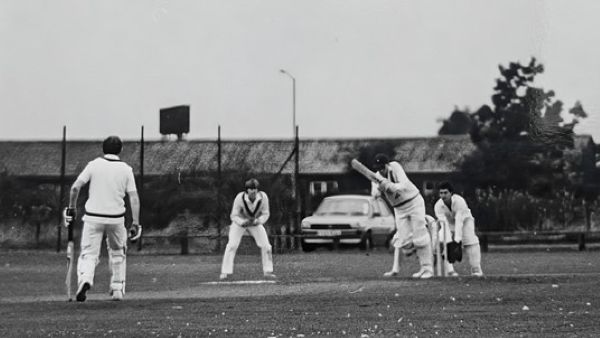
Michael Rea at Stenhousemuir
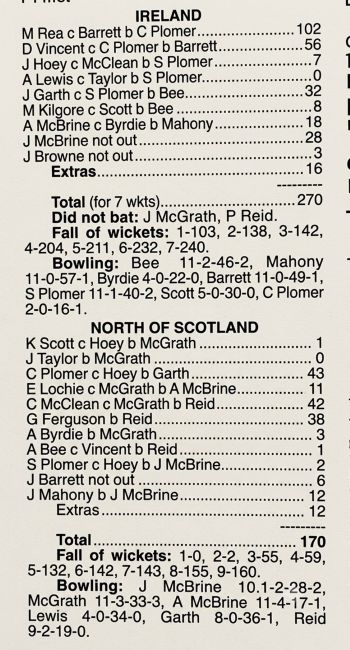
For game 2 we head a little north to the beautiful town of Stirling for the game against The North. The weather continued to be a bit grim and the expectations were that we would be spending more time trying our luck on the ice rink which was part of the same sporting complex as the cricket field. The game was reduced but still was a 55 over game. Batting first this time, we put up a pretty impressive score of 270 for 7.
Michael Rea continued on his good form from game one with an excellent 102, but there were contributions all down the order. For the North there were 2 wickets for opening bowler Andy Bee and S. Plomer. The reply started badly with Johnny McGrath continuing his good form with 2 early wickets leaving the North 2 for 2. Resistance came from C Plomer (43) C. McClean (42) and G Ferguson (38) but excellent bowling throughout but James McBrine’s 2nd wicket ended the game with the North 100 runs short. The Special Correspondent was a bit happier, describing Michael’s hundred as "magnificent", high praise indeed.
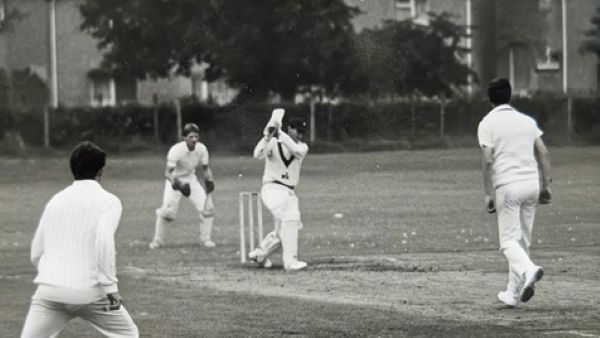
Vincent at Stirling
Game 3 saw us head to Greenock for the game against the East. Unfortunately, the weather really kicked in and no play was possible. I have tried but failed to conjure any recollection of Greenock CC, I have tried Google Maps and that did not help to trigger any memories. The Google Map shows a lovely ground which should be memorable so it is possible that we never even made it to the ground.
And so to the final game, a 2 dayer against our Scottish equivalent at Ayr CC. It came as a surprise many years later when Scot Dom Rigby landed in my home club of Clontarf to find that the Ayr CC that we played at in 1986 was not the current home of the club but a Sainsbury’s supermarket and the new ground was just across the road.
Worries about the weather were well founded. Rain meant that play was delayed on day one for an hour and a quarter and the day ended early for the same reason. But in between it was a decent day for the Irish and we were able to declare at 223 for 7, admittedly after a poor start. We were 20 for 3, with Rea, Vincent and Waite back in the pavilion and watching proceedings. Those proceedings all belonged to Jonathan Garth who completely dominated the Irish innings. Lewis stayed with him until he fell with the score at 84 and then along with John Hoey added 74 for the 5th wicket. Garth brought up his 100 in the process.
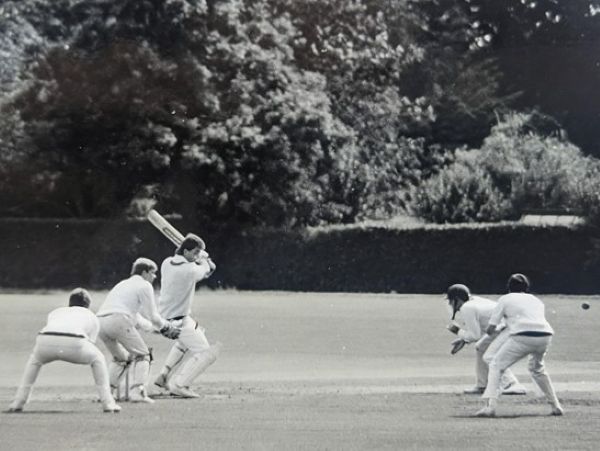
Garth on way to 100 in Ayr
Indicative of his domination of the innings, Hoey’s 27 was the second highest score and even that, by a distance. Captain Lewis declared at 233 for 7 at which stage Bee and Ormiston had 2 wickets each. The Scottish batted for just under 15 overs before the rain came in but by that stage Junior McBrine had begun one of the best ever bowling spells in green. This was despite a good start by Gordon McGurk and G. Hollins who put on 47 for the first wicket before they both succumbed to Junior, one he caught himself, the other by his twin, the safe hands of Donemana.
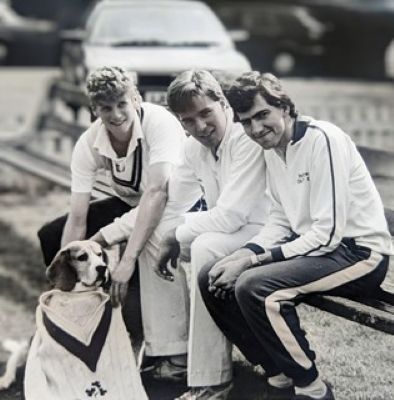
Reid, Rea and Lennon
The morning of Day 2 was all about the McBrines, between them they accounted for 9 of the Scottish first innings wickets with Philip Lennon nicking the 10th. The innings ended just before lunch and Scotland’s total of 120 meant that Lewis was able to enforce the follow on, which he had no hesitation in doing, since it was really the only opportunity to win.
It didn’t take long for Junior to enter the attack again. The wicket had become tricky by this stage and there was no better man to exploit that than Junior. Hollins was the first to fall, he had been defensive and correct but eventually could no longer resist and charged, giving John Bowne, behind the wicket, the opportunity to remove the bails.
The middle order provided resistance with C Plomer the biggest contributor with 68. To be honest I am relying on newspaper reports here, since I wasn’t present for the afternoon session. In those days, batsmen rarely wore helmets, never mind fielders. Personally, I did not even own a helmet so when I was asked to field at silly point, the 12th man was not rushing out with a lid.
Junior bowled magnificently that day but he did bowl one bad ball. That was to Mike Smith, an elegant and excellent batsman and when Junior dropped a little short, Smith smacked towards extra cover. Unfortunately, silly point was in the way and he spent the rest of the afternoon in a local hospital, having his head stitched back together. Lesson learned.
Despite that resistance, Scotland’s innings folded for 179, a lead of 76. James McBrine finished with 2 for 40 and Philip Lennon took 3 for 48 but pride of place again went to Junior McBrine whose 4 wickets cost 32. However, that is only part of the story for in that second innings he bowled 32 overs (of which17 were maidens), having bowled 21 in the first effort.
Bearing in mind that he only completed 3 full overs the night before the scale of his effort becomes apparent, how many of us have bowled the guts of 50 overs in a day?
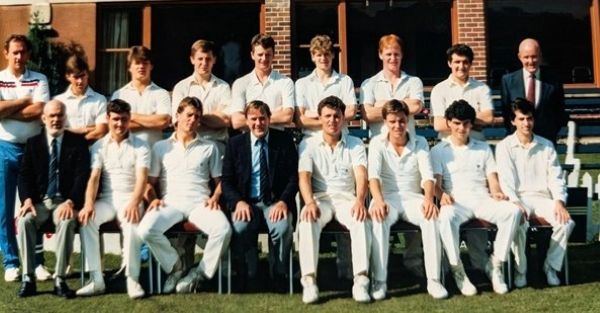
Travelling party at Ayr
There were not too many scares in the final innings of the game with the target of 77 being reached for the loss of 4 wickets in just 18 overs. Lewis leading the way with 29 while Andy Bee continued an excellent series with 3 more wickets.

So honours to the Irish. The beauty of playing against Scotland was that there was always a game to look forward to. The Senior side played an annual 3 day game which was classed as First Class. So just a few years later, in 1988, in Dumfries, Messrs. McGurk, Smith and Bee met up again with Lewis, Rea and Vincent in a fixture that marked the Centenary game, making sure that they finished on the winning side, by some distance. Such is sport.